Showing posts with label Melbourne. Show all posts

Tuesday, 4 September 2012

Lawrence Ormond Butler- Ch. 4: Years 1845-1856


Lawrence Ormond Butler's Third Marriage


Lawrence Butler’s wife Agnes MacPherson was the widow of a Scotch clergyman, according to her job application in 1845. It is unknown what happened to Agnes, however Lawrence either separated from or divorced her, or alternatively, she died. No record of her death has yet been found.

A Shipping Record in the Sydney Morning Herald 28 Feb 1854 (p4) has listed a Mrs Agnes Butler travelling on the Waratah from Sydney to Port Phillip travelling cabin-class- whether this refers to the same woman is unknown.
(NB. A death record for an Agnes Butler died 1909 Geelong, aged 86, born Scotland, refers to an Agnes Blair married to a James Powell Butler)

There is also the possibility that Agnes returned to Scotland from whence she arrived only two months before her fateful marriage to Lawrence. Her brief experience of the new colony was not a happy one.

 According to his death certificate details, Lawrence either remarried or was living with a Frances Rainy sometime in 1845/46 (although there is no known record of the marriage, his death certificate states he was married at the age of 30 ie.1842 which  confuses matters), however, this stated age must have been incorrect- his age at death was incorrect by three years). Lawrence and Fanny had five children between 1846 and 1853- William, Fanny, Emily, Sarah Jane, and a deceased male child.

There is no birth record for William in the BDM records, which may indicate that he was illegitimate. Lawrence sailed from Sydney to Port Phillip on the schooner Martha and Elizabeth in August 1845 and was in Portland 1846 until at least mid-1847. In son William's death certificate of September 1887, William’s age is given as 39 yrs 6 months which indicates he was born in March 1846 and conceived in June 1845 while Lawrence was still married to Agnes.

There are birth records for his two sisters, Fanny in 1850 and Emily in 1853, [1] both born in Sydney.

Lawrence and Fanny's  last child Sarah Jane was born posthumously. Her death record reveals she died in July 1910 aged 51, age at marriage 16 (ie. in 1874 to John Gibson), parents Lawrence Butler, compositor, and Fanny. She therefore must have been born about August 1857, eight months after her father’s death on 24 December 1856, her birth unregistered. 
(NSW Registry of BDM death 1910/8331; marriage to John Gibson 1874/1012)


Agnes Butler’s job application with the Government Printing Office


Lawrence and Agnes returned to Sydney, and they both applied for jobs with the Government Printing Office in early 1845. An application from Lawrence was dated in February and one from Agnes was received by the Printing Office sometime in July 1845. The position was for Matron in charge of the welfare of the apprentices in the Government Printing Office. Interestingly, the eventual successful applicant, a Mrs Holmes, was recommended by Caroline Chisholm. Agnes’s application was endorsed by the Rev. John Dunmore Lang, George Robert Nichols Esq. who was Lawrence’s solicitor to whom Lawrence wrote the letter in 1838 from jail (previously discussed), and Mr John Lett. 
Agnes was described as a “widow of a Scotch Clergyman since married to a compositor in “The Morning Chronicle” office- honest and respectable people”.[2]
Her application had revealed where Lawrence had been employed for the past two years.


Lawrence’s job application to Government Printing Office in 1845

Agnes’s job application was four months after Lawrence also applied for a job in the same government department. His employer, The Morning Chronicle, was published by Michael D’Arcy between 1843-46. The newspaper, the forerunner of the “Catholic Weekly” newspaper, began as “The Australasian Chronicle” in 1839 and underwent several name and management changes, including “The Morning Chronicle”, “The Chronicle”, and “The Sydney Chronicle”. In 1850 it was succeeded by “The Freeman’s Journal”, which was printed on an old hand-turned “mangle” in the gallery of St Mary’s Seminary, a building adjacent to the first St Mary’s Cathedral in Sydney. It was not an “official organ” of the Church, but a general newspaper with a focus on Catholic and Irish affairs. One of its greatest achievements was its work for Catholic education and its tireless crusade against unfair discrimination of denominational schools.” [3]  One of his referees, William Raw, described Lawrence's employment for the past two years as having had the management of a printing office.

The Colonial Secretary’s Correspondence contains two letters written by Lawrence, applying for positions as a clerk and for a position in the printing office. The first application was in February 1845, [4]and indicated that Lawrence was then living in Sydney and he stated he was unemployed.


First application 1845:


Bridge Street, Sydney.
Feb 26th 1845
Lawrence Butler
Sir,
Application for an appointment under Government.

I beg leave very respectfully to lay before you my application for some appointment under the Government, and to submit to you the accompanying testimonials in my behalf.

In soliciting your favourable consideration of my application, I may be permitted to state that, I am Native born of this Colony, that I am a Compositor and that, I have for several years been engaged in that capacity. I am now without employment, owing to the great increase of Tradesmen of this calling and having a wife and two Children depending on my exertions for support.

I beg respectfully to state that, I feel myself qualified for the duties of Clerk to a Clerical situation, but that, I should thankfully accept any appointment for which the Government might be pleased to think me qualified and that it shall ever be my anxious endeavour to show that your Kindness has not been bestowed to an undeserving person.

I beg leave Sir
With the highest respect
To remain Your most
Obedient, humble servant.
Lawrence Butler

Reply:
Let his name be noted in the Book as a candidate for employment and inform him accordingly- adding however, that there is no present vacancy, and it is uncertain when one may occur, whilst there are several other parties whose names stand before him on this list.  27th Feb

Lawrence Butler
28th Feb (ticked)

Testimonials:

I have known Mr Butler for some years-  during the last two he has had the management of a Printing Office. He is a steady industrious young man and in whose integrity I would implicitly rely.
Wm Jn Raw
27 Feb 1845

I have known the bearer Lawrence Butler for some years and have always ___ considered a well behaved person.
A. Macd_____
Sydney 24 Feb 1845

I have known Lawrence Butler for two years during which period I had every opportunity of witnessing his steady and industrious conduct.
Feb 25th 1845    Signature?

I have reason to believe that Lawrence Butler is a young man of honesty and integrity. I do not myself know him, but from strict inquiry I am perfectly satisfied that his character is very good.
J. Long Innes
22 Feb 1845
(This was Captain (later Major) Joseph Long Innes, Sydney magistrate, former officer of the 39th Regiment and Superintendant of Police, married to Elizabeth Reibey, daughter of the famous Mary and Thomas Reibey- their son of the same name, would become an influential politician and judge.)


Charged with absconding from the Portland Gazette


Following the unsuccessful first application in 1845, Lawrence returned to Victoria and obtained a printing job with the Portland Gazette, in Victoria. Portland was one of the trading ports on the Victorian coast often visited by his brother Walter Butler’s trading vessels.

The Australian Thurs 14 Aug 1845 p2,
Shipping Intelligence,
Sailed from Sydney 12 August- The schooner MARTHA & ELIZABETH, for Port Phillip, with sundries. Passengers… Mr Lawrence Butler.

Notably Agnes did not accompany him. By this time he had impregnated Fanny Rainy, so maybe this affair resulted in their separation. Also notably, Fanny was not with him either. She gave birth to William in Sydney in the following year.


The “Melbourne Argus’ reported that, once again, Lawrence had broken his employment contract and was again charged and imprisoned.

The Argus- Tues 8 June 1847 p2
Supreme Court
In Chambers
Friday 4th June 1847
(Before His Honor the Resident Judge)
Lawrence Ormond Butler, a prisoner confined in the Melbourne Gaol, under a sentence of the Portland Bench, appeared on a writ of Habeas Corpus, to apply for his discharge.
Mr F. Stephen, solicitor, moved His Honor to order the discharge of the prisoner on the ground of numerous technical informalities in the warrant of commitment, which was signed by James Blair, Esq, Police Magistrate of Portland, and S.G. Heaty Esq, J.P. From Mr Stephen’s statement, it appeared that Butler, who is a compositor, had been sentenced to three months imprisonment, and amerced in the sum of ₤1 6s 6d. costs, on a charge of absconding from the hired service of Mr Osborne, proprietor of the Portland Gazette.
His Honor granted the application, and Butler was discharged accordingly.


The Cornwall Chronicle (Launceston) Wed 23 June 1847 p2, discussed the case and harsh verdict and made a scathing comment on the local magistrate:

[From the Portland Guardian]

A FLAW IN THE COMMITTAL-On Friday last, a person named Lawrence Ormond Butlers, who had been committed to gaol for three months under the Masters and Servants Act, by the Portland Bench, was brought before is Honor the Resident Judge in chambers, and released from custody, the committal exhibiting even a greater want of knowledge of that sublime science the law, than many commitments emanating from the Melbourne Bench. Considerable harshness appears to have been exhibited by the Portland Bench towards Butler, who was not only sentenced to three months imprisonment, but was directed to pay costs to the amount of one pound six shillings and sixpence- P.P. Patriot.

(The journalist continued) 
Here is a rich example of stipendiary talent; a portrait of the doings of the police magistrate of Portland; a gorgeous display of Portland Police efficiency; an exhibition of the rare judicial qualities of our salaried P.M. and an honorary J.P. combined. Each day, as it arrives, adds some fresh instance of the utter incompetency of the Portland Bench      , under its present lame management, to command the confidence of the inhabitants. The sentence passed upon the unfortunate man, whom the bench got into their power, was illegal and disgraceful. It was the most vindictive sentence that any bench could pass, with the least colour of the law to commend it. It has met its equitable reward, the shame, and scandal of the bench by which it was ___.

What does Mr Blair receive his salary for, if it not to perform the duties of the magistracy creditably to the Government by which he is appointed? Yet here is another scandalous transaction occurring, reflecting disgrace upon the district, upon the whole body of the Port Phillip Magistracy, and most of all upon the Government which appointed and still upholds an incompetent officer. He is filling his coffers at both ends: his salary going on while he is attending to his private affairs to the neglect of his public duties, and to the mismanagement of the police business. Mr Blair will never make a magistrate. Etc. etc.

Interestingly Lawrence Butler’s case was used in a defence by another employee “refusing to work’, who claimed that he did not come under the “Masters and Servants” Act, just as L. O. Butler had been released under the terms of that Act. ( Argus Tues 28 Nov 1848 p2)

There was also an enquiry to be held into the conduct of the gaolers where Lawrence was incarcerated in 1847. A scathing editorial in the Port Philip Gazette & Settlers Journal, Mon 12 July 1847 p2, named Lawrence:


How Lawrence managed to gain employment with his record of absconding from his employment, is difficult to understand. His reputation as a poor employment risk was now widespread throughout the colony. Why he continually absconded is also difficult to understand given that he was now of a mature age. He must have gained another position in the following two years as he was recorded as a printer in Collins Street Melbourne in the Port Phillip/Victorian Directory of 1849. Collins Street contained most of the Melbourne newspapers at that time. And in a court case in November 1849 Lawrence was described as the overseer of the 'Victorian Colonist Office'.

The Geelong Advertiser Tues 6 November 1849 page 2 reported: 
COURT OF REQUESTS
Forrest v. Webster
Claim for advertising a dissolution of partnership in the Corio Chronicle, etc. etc.
Forrest v. Lawrence Butler
Defendant is overseer of the Victorian Colonist Office and was in the office at the time plaintiff was proprietor of the Corio Chronicle. The advertisement had been placed in the hand of the defendant by a Mrs Brown, and defendant gave it in for insertion but merely as one connected with the establishment. Judgment for the defendant.


Old Post Office Melbourne 1853 by J.B. Philip
State Library of Victoria Accession No. H2100; Image3 nc000739


The second government job application by Lawrence Ormond Butler


Sometime in early 1850, Lawrence moved back to Sydney, where he once again unsuccessfully applied for a position in the Government Printing Office [6] , reminding them of his previous application and their promise to consider his appointment when a position became available, and claiming he was unemployed again. He had returned to live with Fanny. His given address on his daughter Fanny’s birth record on 15 September 1850 is Pitt Street.
The reply to the second application in 1850 was to be directed to a Mr Alcock, a printer. Edward Alcock was a publisher, editor and printer in the City Printing Office between 1844 and 1847, and then a printer in George Street. [5]

Interestingly, Lawrence claimed in both of his applications that he was supporting ‘two children’. The first application in 1845 would have referred to his child George Henry by his first wife. The second child is unknown at this stage- possibly this was the deceased child listed on Lawrence’s death certificate, and may have either been a child of his marriage with Agnes Macpherson, or a child from his relationship with Fanny Rainy. (A record of this child has yet to be found.)
The two children referred to on his second application in 1850 may have referred to 16 year old George Henry and 4 year old William, or to William and the deceased male child.

Colonial Secretary’s Correspondence Index to Convicts & Others 1848 to 1853- extracted by Joan Reese

Primary Source SRNSW  Letter/Ref 50/4790  Shelf 4/2900   Lawrence Butler- SHIP/ID  compositor


14th May 1850
To the Honorable Edward Deas Thomson
Colonial Secretary &c., &c.
The Petition of Lawrence Butler

Humbly Shewith,

That your Petitioner is a Native of the Colony by trade of Compositor, and that has a wife and two children.

He further begs leave to state that five years back, he applied for a situation in the Mechanical department of the Government Printing Office, his application being accompanied with Testimonials of character and ability, and that such being approved of he was promised the first vacancy.

He therefore respectfully begs leave to renew his application, humbly trusting that being out of employment with a family to provide for, it will meet with your sympathy.

And your Petitioner will ever pray,
Lawrence Butler

Sydney May 13 1850
Address: Care of Mr Alcock
Printer
Opposite old Burial Ground George Street South
(i.e Edward Alcock, City Printing Office 1844-47)

For Lawrence Butler

On back: Refer to W. Davies
15th May
signed ?
17th May 1850

__ for the Colonial Secretary
signed ?

To be returned.
At present there is no vacancy and there are already two applicants on the list.
I have brought the subject under the notice of the Board.
WW Davies.

To be informed
25th May

Death of Lawrence Ormond Butler


 Lawrence died in Macquarie Street of consumption in 1856 at the young age of 44.

The Sydney Morning Herald 25 Dec 1856 p1:
DEATHS: Yesterday at his residence, Macquarie-street, of Consumption, Lawrence Ormond Butler, compositor, aged 41 years.


Notably his given age in the newspaper and certificate was incorrect.
His death certificate named Fanny Rainy as his wife, and only listed his children by her. He was still listed as a 'compositor'. Notably, his eldest son George Henry Ormond (b.1834) would also become a printer, and was possibly apprenticed to his father at one time, or at least learned his trade from him. George would eventually become Senior Officer in the Government Printing Office in Sydney.

Interestingly, the Minister named on his death certificate was of the Church of England- as he married his first and second wives in the Presbyterian church, he was obviously no longer a practicing Catholic, although he maintained a close association with the Catholic community as evidenced by the support given him by Bishop Geoghegan in his petition to the Court in Melbourne in 1841, and, his subsequent work for the Catholic newspaper in Sydney in 1845.


© B.A. Butler

contact  butler1802 @hotmail.com (no spaces)

Link back to Introduction
http://butlerfamilyhistoryaus1.blogspot.com.au/2012/09/lawrence-butler-jnr-introduction.html

Links to all chapters in this blog:

Lawrence Butler Junior's childhood, education, and apprenticeship as a compositor
http://butlerfamilyhistoryaus1.blogspot.com.au/2012/09/lawrence-butler-jnr-ch-1-education-and.html
Lawrence Butler's life as a compositor in years 1833 to 1839, and first marriage
http://butlerfamilyhistoryaus1.blogspot.com.au/2012/09/lawrence-butler-jnr-ch-2-years-1833-1839.html
Lawrence Ormond Butler's life in Melbourne 1839 to 1844, and second marriage
http://butlerfamilyhistoryaus1.blogspot.com.au/2012/09/lawrence-ormond-butler-ch-3-years-1839.html
Lawrence Ormond Butler's life in years 1845 until his death in 1856, and third marriage
http://butlerfamilyhistoryaus1.blogspot.com.au/2012/09/lawrence-ormond-butler-ch-4-years-1845.html
Issue of Lawrence Ormond Butler
http://butlerfamilyhistoryaus1.blogspot.com.au/2012/09/lawrence-ormond-butler-ch-5-issue-of.html
The significance of the middle  name of 'Ormond'
http://butlerfamilyhistoryaus1.blogspot.com.au/2012/09/lawrence.ormond.butler.ch.6.name.ormond.html
The history of the Butlers
http://butlerfamilyhistoryaus1.blogspot.com.au/2012/09/lawrence-ormond-butler-ch-7-history-of-butlers.html
The different branches of Butlers in Ireland
http://butlerfamilyhistoryaus1.blogspot.com.au/2012/09/lawrence-ormond-butler-ch-8-butler-branches-ireland.html
The MacRichard line of Butlers in Ireland
http://butlerfamilyhistoryaus1.blogspot.com.au/2012/09/lawrence-ormond-butler-ch-9-macrichard.html


[1] NSW Registry of BDM;  7243 V45C/1850- birth Fanny Butler, 724/1874- marriage Fanny to James Killian,  21845/1936-death;  855 V35/1853- birth Emily Butler, 2095/1884 marriage Emily to William O'Toole, 19492/1929-death;
 death Sarah Jane Gibson- 8331/1910; marriage to John Gibson 1012/1874
[2] SRNSW: Colonial Secretary’s Corres.- Index to Convicts and Others 1845- Letter 45/5986; Shelf 4/2688.6; Agnes Butler
[3] www. catholicweekly.com.au
[4] SRNSW: Colonial Secretary’s Correspondence Index to Convicts & Others 1843 to 1847- extracted by Joan Reese
Primary Source SRNSW  Letter No 45/1522  Shelf 4/2693.1   Lawrence Butler   SHIP/ID- for employment
[5] http://www.printsandprintmaking.gov.au/catalogues/artist/14612/edward-alcock.aspx
[6] SRNSW: Colonial Secretary’s Correspondence Index to Convicts & Others 1848 to 1853- extracted by Joan Reese

Primary Source SRNSW  Letter/Ref 50/4790  Shelf 4/2900   Lawrence Butler- SHIP/ID  compositor


Sunday, 2 September 2012

Lawrence Ormond Butler- Ch. 3: Years 1839-1844 in Melbourne


Elizabeth Street Melbourne in 1844
by Alfred Martin Ebsworth in 1888
(State Library of Victoria Accession no. A/S06/09/88/133; Image No. mp10130)


Lawrence Ormond Butler's Second Marriage and re-location to Melbourne


Shortly after his release from prison at Liverpool, Lawrence Ormond Butler relocated to the newly developing settlement of Melbourne. The recently widowed Lawrence then married Agnes MacPherson in Melbourne 31 December 1839 in the Presbyterian Church of Scotland, Melbourne. Agnes later described herself in a job application as the 'widow of a Scottish clergyman'. However, another website[i] has Agnes MacPherson as the only daughter of Captain John MacPherson of the 76th Regiment of Foot. Miss Agnes MacPherson arrived as a cabin passenger on the ‘Caledonia’ from Leith, Edinburgh, Scotland on 18 September 1839. It left Leith on 17 April via Bahia 25 June 1839. She was described as ‘Miss’ Agnes MacPherson on the list,[ii] but this may be explained by the tradition that Scottish women retained their maiden names.


Lawrence moved to Melbourne in 1839 before his brother Walter Butler, who went to Melbourne before March 1841.
In the Port Phillip Directory for 1841, Lawrence is listed as a compositor in Bourke Street Melbourne, and a Mrs Butler is listed at a boarding house in Bourke Street (which is probably the house they leased for use as a public house, as described below).

Notably, by the 1840's, records and newspapers relating to Lawrence Butler always named him as Lawrence Ormond Butler. This distinguishes him from another Lawrence Butler transported to Tasmania in December 1840 on the 'Egyptian 2'- tried in Tipperary for theft of wool and sentenced to 7 years, pardoned in 1844. When charged, he was a married man aged 50 years with four children. A third man by the name of Laurence Butter (sometimes Butler) arrived in Tasmania on the 'Nile' in 1850, aged 31, tried for theft in Edinburgh, a painter, who married in 1853 and died in 1872 in Hobart.

1841 was an eventful year for Lawrence Ormond Butler. The following information was found in “The Port Philip Patriot” newspaper:

Application for publican’s license in Melbourne


On April 22, 1841, Lawrence Butler’s application for a publican’s license for the ‘Irish Harp’ was denied, with the qualification “until the present tenant leaves”.
On May 24, 1841, a special meeting of the Justices was held at the Police-office, on behalf of Mr L.O. Butler who had applied for the license for the 'Irish Harp' presently in the occupation of Mr Heany, whose application was refused last licensing day. Butler's lawyer said his client had taken the house, purposely for a public-house, for two years, at a very high rent. However, the Justices stated they had been determined at the General Licensing Meeting not to grant any fresh licenses during the year and they were not going to establish a rule one month and break it the next. The application was refused.
This 'house' he was renting was probably the 'boarding house' in Bourke Street that 'Mrs Butler' was residing at in the 1841 Port Phillip Directory.

Melbourne 1839

However, this ruling by the Justices did not seem to apply to everyone. On the 3rd May 1841, Lawrence’s brother, Walter Butler was granted the licence for the “Ship Inn” at Williamstown. In the “Patriot” newspaper Walter’s marriage to Frances Edwards on the 22nd October was announced, and described “Walter Butler, Esq. of Williamstown”.

Public Dispute between the newspaper employers of Lawrence Ormond Butler


Lawrence was then embroiled in a very public dispute involving himself and his past and present employers, both newspaper editors/newspaper proprietors. Sometime, before June 1841, Laurence had been employed for a short while in a temporary position, as the overseer of the printing department for William Kerr the editor of the “Port Philip Patriot”, proprietor John Pascoe Fawkner. Lawrence left his employ sometime before June and was employed by rival newspaper editor George Cavanagh at the “The Port Phillip Herald”. (Cavanagh having previously been employed at the “Sydney Gazette”, during the time of Lawrence Butler’s controversial employment there, and was editor in 1836-1839. [iii])

Lawrence was accused of divulging information about his previous employment to his new employer, Cavanagh, who promptly published the information signed by Butler, in an editorial in his newspaper, resulting in the wrath of John Fawkner, proprietor of the “Port Phillip Patriot”, and William Kerr, editor. Fawkner is recognised as the father of Melbourne, having founded a settlement there in 1835 (along with John Batman).

Notably, Kerr had been employed by Cavanagh as editor of his newspaper, the “Port Phillip Herald” the previous year. Kerr had ‘left’ his employ and started with the “Patriot” in January 1841.

George Cavanagh had previously been appointed editor of the “Sydney Gazette” in 1836. The following year, 1837, Kerr emigrated to Sydney from England (Kerr b.1812 d. 1859). After initially working for the “Colonist”, he joined the “Sydney Gazette”, probably personally employed by Cavanagh. In 1839, Cavanagh took his family, staff and machinery to Melbourne and on 3 January 1840 published the first issue of the 'Port Phillip Herald'. He must have taken Kerr with him, as Kerr also went to Melbourne in 1839 and was employed by Cavanagh.
They must have had some issues, as Kerr only remained with Cavanagh for about one year, before taking employment as editor of rival newspaper, the 'Port Phillip Patriot'. A bitter feud then erupted between the two rival newspaper editors.

In 1844 Kerr and Fawkner quarrelled, yet Kerr continued as Editor and changed the policy of the “Patriot”.
 “Superintendant Charles La Trobe stated that it dealt systematically ‘in abuse and gross misrepresentations of persons and facts.’. Kerr even used his editorials to vilify its proprietor Fawkner, who was driven to reply in the columns of the hated “Herald”. Soon afterwards Kerr left the “Patriot” and in 1849 started his own “Argus”. He became insolvent and sold the “Argus” but continued as Editor. The paper was renowned as ‘extremely radical’. He became one of the first four aldermen and Melbourne’s second town clerk.
Kerr was a man of many violent enthusiasms and abounding energy. His language was unrestrained and during his 20 years in Port Phillip he quarrelled with most of the leading citizens. He was given to stinging and sarcastic personal abuse of his opponents.” (ref-ADB- Kerr)


William Kerr
 (State Library of Victoria Accession no H92.330/181;   Call no PCV LTGN 7

John Pascoe Fawkner (1792-1867)
by William Strutt (Courtesy NLA n/a.pic.an.2268302)


The character of this man, Kerr, puts the following events into context, and
the following newspaper articles in the 'Port Phillip Patriot' give an idea of the strength of Kerr’s wrath:

Mon June 14, 1841- Kerr begins by attacking the character of Cavanagh;
“To Mr George Cavenagh
Sir- You have come amongst the Melbournians professedly to reform the Press- at least so the paper you PROFESS to Edit very pompously asserted. Now I beg to ask how have you redeemed this vain-glorious boast?
You are the only Melbourne Printer that has been warned to appear before the Supreme Court for the libel on private character… You have disgusted the whole of the reasonable and thinking portion of this community, by the virulent attacks of yourself and coadjutor upon private character- attacks made with no public object in view, but merely to gratify your malignant passions. Now “Reformer of the Press of Melbourne” I have to ask you, what complaint could you make? With what reason could you appeal to the public, should any, or all of your workmen, for private ends, to injure you, or to benefit any other newspaper proprietor, divulge the private secrets, or important intelligence which you entrust him to set up-- in the face of your tampering with my late servant LAWRENCE ORMOND BUTLER (NB- written in capital letters in the newspaper), (I give the name to the world for information) to obtain a knowledge of the affairs of my office; and mind, I pledge my word that he has given you false! Utterly false! Information. Yes! And you have persuaded the mean wretch to append his name, and have given circulation to his certain damnation among the printers wherever your widely circulating paper may happen to go-- thus sealing your own fame with his. (NB they divulged the circulation figures of the ‘Patriot’.)
Now Sir, you will have achieved a great victory, no doubt, that is to say, if you have perfectly succeeded in releasing the whole body of printers from their responsibilities, if, though you and your associate-- worthy Lawrence Ormond Butler, you have removed the bond of secrecy by which every person in a printing office has hitherto been restrained, and have shown them that printers may publish to the world whatever may have been entrusted to them under the impression that the secrets of the trade are sacred. If you have accomplished this noble feat, I hope you may live many years as a printer, to enjoy the fruits of your own deserts.”
I am, Sir
JOHN P. FAWKNER
PS- I challenge you and your associate to come forward and prove ON OATH, the circulation of the Patriot, but I advise you to be cautious for I shall not hesitate to bring you up for wilful and corrupt perjury, if you should have the fool-hardiness to reiterate your statement on oath.

The vitriol continued:
George Cavanagh, Esquire, the editor, printer, publisher, and by some unintelligible means, sole proprietor of the Port Phillip Herald, has put the copestone to his reputation as a gentleman and as an honest tradesman in his paper of Friday last, by the publication of a letter from one of our cast-off servants (a scoundrel named Laurence Ormond Butler), who it seems has been pandering to the baseness of its present employer by attempting to betray secrets of the office he has just left. Fortunately for us he had it not in his power to do more than attempt, for knowing the character of the man from his previous doings in Sydney and at Hobart Town, when we unwillingly received him into the office for a few weeks, as a substitute for our overseer who had been obliged to proceed temporarily to South Australia, we did not admit him so far to our confidence as to entrust him with the issue of the paper, or the control of the press-room, and it was consequently not in his power to do more than guess at our circulation…. The circulation of the “Patriot”, at the time it came under our charge was low- lower even than honest Larry has guessed at…

We are not yet done with George Cavanagh Esq. and his infamous tool Laurence Ormond Butler. We have now been a good many years connected with the press, and to the credit of the printers we must
state that, excepting in the case of a convict compositor in the “Sydney Herald Office”, who betrayed his employers by purloining a proof of an unpublished libel and handing it over to the party libelled, we never knew a printer guilty of such cool, deliberate treachery as this of Laurence Ormond Butler. Drunken, dissolute, improvident beings, as but too many of them are, we never knew another instance of a printer voluntarily disclosing to a rival establishment the secrets of an office with which he was connected, and we feel perfectly satisfied that the trade will note such a dereliction from honourable principle, by expulsion from their society. Paltry and disreputable however, as every employer of labour will consider Butler’s conduct, it does not match in downright blackguardism the conduct of Mr George Cavanagh… We have no very high opinion of the self-styled aristocracy of Melbourne, but as Mr Cavanagh is an aristocrat of the first water, we shall look to their reception of him after such dishonourable behaviour, as a sure test by which to estimate their own pretensions to respectability, for we have no hesitation in saying that no one who has any claim to the character of a gentleman would suffer a man who has been guilty of the odious crime of tampering with the honesty of another man’s servant to enter his society.”

Thurs June 17: “Laurence Ormond Butler, a Compositor, late of this office, having obviously with a view of injuring his late employer, communicated to the proprietor of the ‘Herald’ what he believed to be the circulation of the ‘Patriot’, the Editor of the ‘Patriot’ will feel obliged if the Compositors and Pressmen employed in the Patriot office will favour him with their opinion, in time for tomorrow’s ‘Patriot’ on the following queries, viz: whether, according to the usage of the trade, Butler has, in this matter, been guilty of “a breach of Confidence?” and whether it is proper for any Compositor or Pressman to mention the circulation of any newspaper with which he may be, or has been, at any time connected, if not cautioned by his employer to the contrary, such information being given expressly to be used to the prejudice of the proprietor of such newspaper?’

He received the following responses:
The Printers of this establishment, that although Printers are not bound to secrecy more than prudence may dictate, yet, that it is a gross breach of confidence, and in the highest degree improper for any printer to make public any information which he may have obtained while in the service of his employer, and that in the case of Butler, the offence is aggravated by his having held the confidential situation of Overseer in the Patriot offices…
The Compositors and Pressmen replied: That on their minds there is not the shadow of a doubt but that he, Butler, has been guilty of a flagrant breach of confidence—not so much, in their opinion, in answering the question when first put to him by Mr Cavanagh, for he might then have been thrown off his guard, as in his published statement, which they esteem unparalleled and unpardonable offence against his late employer.

Cavanagh then replied in his newspaper, The Port Phillip Herald:
 “publicly avowing that he maintained he was guilty of no offence and Butler was blameless in disclosing what he supposed he knew, because his late employer had never warned him not to do him an injury”.

Kerr, in response, said:
 “Our honest contemporary goes even farther than this, for he attempts to justify the treachery of a man who makes use of the knowledge acquired in a particular service to the injury of his employer. It would be a waste of words to comment on such a defence. Although aware that amongst honest men, there could be no second opinion as to Cavanagh’s baseness and Butler’s turpitude, we were yet desirous to have the opinion of the Printers in each of the newspaper offices, as to the light in which such a departure from the principles of rectitude was viewed by the trade.”

Kerr then issued a challenge to Mr Cavanagh that two gentlemen, mutually chosen as scrutineers, shall inspect the books of both newspapers to obtain accurate information on the circulation. He repeated this in several issues, to no avail.

On Mon July 12, Kerr reprinted an article from the “Herald” which also called for both papers to submit their circulation figures, using Kerr’s own words from his previous challenges.
Kerr, finishes by saying:
 “there, gentle reader, there, considering the quarter it comes from, is a notable flight of fancy for you. Alas for the cause of truth, honesty and honour!!!—Think of that Larry Butler.”

On Monday 16 July, Kerr wrote scathingly about Cavanagh:
“Our notable contemporary the ‘Herald’, strongly resembles the dunghill cock- when he has the field to himself, he crows and claps his wings, but hides his diminished head whenever there is a risk of coming into contact with a bird of better breeding. This is just the Herald’s position now; when challenged to enter the field in right earnest, the faint- hearted craven was deaf to the voice of the charmer- but the danger is no soon over than he perches on the summit of his own dunghill, and crows as crousely, and claps his wings as bravely, as if all the world did not know he had shewn the white feather. He crows, however, in vain, for till he thinks fit to submit to the ordeal to which for weeks back he has been challenged, he cannot expect that any notice will be taken of his bravadoes.”


John Fawkner's Printing Office- The 'Port Phillip Patriot'


Source: Museum Victoria-


Lawrence Butler's assault conviction and gaol sentence


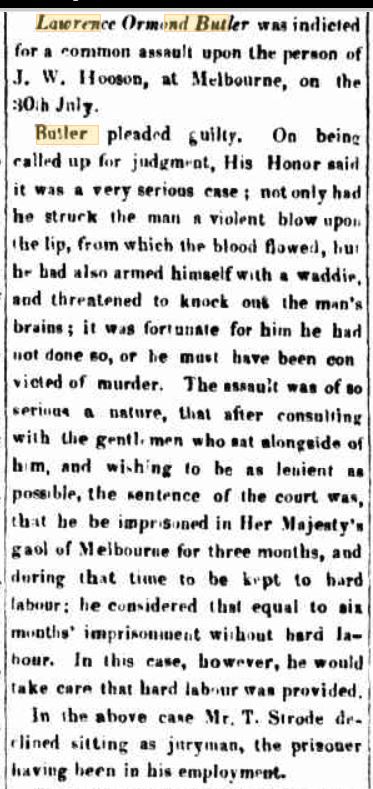
Sometime during the next month Lawrence Butler ended up behind bars for an assault on a court bailiff:
Thurs August 19, 1841- an article in the “Port Phillip Patriot” entitled:
“Inaccurate reporting-
What with blunders of intention, unwitting blunders, and blunders of every shape and description, we shall not feel very much surprised if one day or other our friend of the ‘Herald’ blunders himself into the body of Her Majesty’s jail, where his friend Larry Butler is employed “nappin stones”.” (ie.- breaking up rocks with a sledgehammer).

The Port Phillip Patriot, 31 July 1841, first reported details of the assault:


Port Phillip Patriot, Sat  August 21, 1841 p4:

Mon August 23:
“It will be seen from the Supreme Court report in another column that Mr Cavanagh has narrowly escaped “getting into trouble”, (as his friend Larry would call it,) on account of his misrepresentation of the Judge’s remarks in reference to the difficulties the Crown Prosecutor labours under from the irregular manner in which the depositions and recognizances are frequently furnished from the Police Courts.”

Lawrence was released from jail in September:
Thurs 16 September: “The court then adjourned for one hour. On his Honour resuming his seat, addressing the crown prosecutor, he observed, that he had received a petition praying a remission of sentence, from the wife of Lawrence Ormond Butler who was convicted last sessions for an assault on the bailiff of another court, and he had, under all the circumstances of the case and learning the good character of Butler’s wife, and her present destitute condition, owing to her husband’s imprisonment, recommended a commutation of the prisoner’s sentence.”
The Port Phillip Gazette 18 Sept 1841 reported:


This shortened jail sentence indicates that the assault on the bailiff had not been considered to be of a serious nature, and probably occurred, once again, in a flare-up of Lawrence’s now notorious temper.


Lawrence had written a Petition for a remittance of his sentence [iv]:

27 Sept 1841

Petition from L.O. Butler for remission of Sentence:


Melbourne  22nd Sept 1841
The Honourable
The Colonial Secretary
Sydney

Sir,
I have the honor to enclose a Memorial from the party named in the margin (ie.  Lawrence Ormond Butler) to His Honor the Resident Judge.

The Petitioner was convicted of an assault at the Supreme Court of this District in the 16th of August, and sentenced to three months imprisonment with hard labour.
The Petitioner having been in prison one month sets forth his claim for remittance of the remainder of the sentence. The Petitioner will be found to be backed by the Roman Catholic clergyman and others, and in addition to bear the recommendation of His Honor Mr Justice Willes and the Crown Prosecutor.
Under these circumstances I considered that His Excellency would not be indisposed to grant the remission prayed for and have ventured to ____ authority to give an order for the discharge of Butler.
I have the honor to be for Your most obedient Servant.

______ signature (C.L. Lascock?)

To John Walpole Willes, Resident Judge of Port Phillip and it’s dependencies &c, &c, &c.

The Respectful Petition of Lawrence Ormond Butler humbly shewith.

That your Petitioner fully convinced of your Honor’s merciful disposition ventures this to solicit his interference in his behalf.
Conscious as he is of having transgressed the laws and that the sentence under which he at present suffers has been justly merited, he still entertains the hope that your Honor will be Kindly pleased to take into consideration that your Petitioner has a wife entirely depending upon him for that support which by his act he is unable to afford the hardships of imprisonment which he endures would be patiently borne, and the lesson which they teach he trusts will produce that moral reformation which is the object of all punishment, but when he reflects upon the privations to which an innocent and unprotected wife suffers for his errors, and that she is not only friendless but penniless, he fervently prays your Honor’s compassion to remit the remaining part of his sentence, and relies with a firm confidence upon his present _____ that he will be duly grateful for the merciful Act and never again so far commit himself as to bring ruin upon an innocent dependant and disgrace upon himself.

Hoping that the Liberty taken will be excused as the result of absolute necessity and for the purpose of rescuing a helpless wife from starvation and extreme mental torture, your Petitioner leaves his fate in your hand and should you deem the granting of his request as not interfering with the course of justice or calculated to form a precedent for future applications of a similar nature, your respectful suppliant will, as in duty bound, ever pray for peace and prosperity to smile upon you and that Heaven may bless your family with that happiness of which a hasty act has deprived.
Your Humble and Respectful Servant
Lawrence Ormond Butler


Melbourne Jail
 23rd Sept 1841.
We the undersigned respectfully beg to recommend the prayer of the foregoing Memorial to Your Honor’s humane consideration.

I beg most earnestly to commend this Petitioner to the charitable consideration of His Honor, Judge Willes, especially for the sake of the Petitioner’s wife who is a most exemplary woman.

Signed
P.B. Geoghegan_____  (R.C. Priest, Melbourne, born 1805 Dublin; sent to establish the first Catholic mission in Melbourne and laid foundation stone for St Francis’s Church in Oct 1841)
R.C. ___ PM Phillips
Thomas Clark(?)
Geo Cavanagh (Lawrence’s employer at the “Herald”)

Taking into con___ with regard to _____ of Requests which have come to my knowledge and the contrition expressed by the Prisoner, I think I may safely recommend a remittance of the remainder of the Petitioner’s Sentence- the Crown Prosecutor concurs in this recommendation.
John Walpole Willes
Resident Judge
Sept 15  1841
James Cro_____
Crown Prosecutor


If his Honor the Resident Judge considers the case one in which indulgence can with propriety be shewn, it will give me great pleasure to do what lies in my power to forward his Honor’s views.
15 Sept 1841
C.I. Lascock (?)”
Noted: Let the remainder of the sentence  be remitted
Signed G.S Sept 28-


No further mention of the dispute between the rival newspapers occurred. Notably, in one of the above articles, Kerr states that 'Knowing the character of the man (viz. Lawrence) from his previous doings in Sydney and at Hobart Town', etc. This obviously refers to Lawrence Butler's frequent brushes with the law and short stints in prison in consequence of his 'absconding' behaviour with several previous employers, in 1828, 1830, 1832, 1835, 1836, and 1837 followed by a stint in Liverpool Gaol in 1838. The earliest record found of Lawrence being in Hobart Town was in 1832 after he absconded as an apprentice to Arthur Hill at the 'Sydney Monitor', and found to be employed by Henry Melville the proprietor of 'The Colonial Times' in Hobart. Three years later he may have been in Hobart, after he had absconded from his employment from the 'Sydney Gazette'. We also know he was in Hobart early in 1836, returning by mid-year, and between February and April in 1837, as previously outlined. Whether Lawrence worked in Hobart for his brother-in-law's newspaper 'The Colonial Times' during these later periods is unknown.

By this time Lawrence Butler's controversial reputation was becoming well established throughout the colony. Even so he must have been very efficient at his job to still gain employment.

Shortly after his release from jail, it would appear that Lawrence had decided to try his luck in the young settlement of South Australia (first settled in 1836). Once again, he tried his luck with a publican's licence, but by June 1842 his licence had expired.
The South Australian newspaper Friday 10 June 1842 p2 advert:


The South Australian, Friday 1 July 1842:


The Southern Australian (Adelaide) Fri 11 March 1842 p3, reported:
SUPREME COURT CRIMINAL SITTINGS, SYDNEY, Wed March 9, 1842
"Elisha Cooper was then put to the bar on the charge of burglariously entering the house of John Reynell of Reynella Farm and carrying away property in January last, and pleaded not guilty.
Mr Reynell of Reynella Farm on the Onkaparinga Road (now the town of Reynella a few kms south of Adelaide, South Australia), described the circumstances attending the robbery, the principal feature of which was, that the property was abstracted during the night without at all disturbing the family.
Lawrence Ormond Butler identified the prisoner as a person who had offered him a gold watch on the Friday before he was apprehended. Prisoner and another person came and stopped all night at the witness's house, and, on the following day, the other man left, but the prisoner stopped the whole day. Witness' description of the watch answered to that given by Mr Reynell as abstracted from his house. Prisoner offered the watch for £3, and witness told him he thought he could not have come honestly by it to offer it for that money. Prisoner said that it had been on "the cross", but that it was all right now, for he had brought it from Van Diemen's Land. After the testimony of other witnesses, His Honor summed up and the jury returned a verdict of Not Guilty.
The prisoner was again out to the bar on the charge of forging and uttering sundry Bank of Adelaide cheques or orders with intent to defraud. This time the prisoner was found guilty."

The article states this court sitting took place in Sydney, but does not indicate the location of Lawrence Butler's premises ('witness's house') or where the defendant had offered him the watch in question. The robbery took place on a farm on the Onkarparinka Road near Adelaide, which may have been near the location of Lawrence's 'Kensington Arms' hotel. It is not clear why the case was held in Sydney.

No more is heard of Lawrence until 1845 in Sydney.

© B.A. Butler

contact  butler1802 @  hotmail.com (no spaces)

Link back to Introduction
http://butlerfamilyhistoryaus1.blogspot.com.au/2012/09/lawrence-butler-jnr-introduction.html

Links to all chapters in this blog:

Lawrence Butler Junior's childhood, education, and apprenticeship as a compositor
http://butlerfamilyhistoryaus1.blogspot.com.au/2012/09/lawrence-butler-jnr-ch-1-education-and.html
Lawrence Butler's life as a compositor in years 1833 to 1839, and first marriage
http://butlerfamilyhistoryaus1.blogspot.com.au/2012/09/lawrence-butler-jnr-ch-2-years-1833-1839.html
Lawrence Ormond Butler's life in Melbourne 1839 to 1844, and second marriage
http://butlerfamilyhistoryaus1.blogspot.com.au/2012/09/lawrence-ormond-butler-ch-3-years-1839.html
Lawrence Ormond Butler's life in years 1845 until his death in 1856, and third marriage
http://butlerfamilyhistoryaus1.blogspot.com.au/2012/09/lawrence-ormond-butler-ch-4-years-1845.html
Issue of Lawrence Ormond Butler
http://butlerfamilyhistoryaus1.blogspot.com.au/2012/09/lawrence-ormond-butler-ch-5-issue-of.html
The significance of the middle  name of 'Ormond'
http://butlerfamilyhistoryaus1.blogspot.com.au/2012/09/lawrence.ormond.butler.ch.6.name.ormond.html
The history of the Butlers
http://butlerfamilyhistoryaus1.blogspot.com.au/2012/09/lawrence-ormond-butler-ch-7-history-of-butlers.html
The different branches of Butlers in Ireland
http://butlerfamilyhistoryaus1.blogspot.com.au/2012/09/lawrence-ormond-butler-ch-8-butler-branches-ireland.html
The MacRichard line of Butlers in Ireland
http://butlerfamilyhistoryaus1.blogspot.com.au/2012/09/lawrence-ormond-butler-ch-9-macrichard.html


[ii] http://ship47.site88.net/b/b39.html  The 76th Regiment of Foot, a Scottish Regiment, was sent to India in the 1830’s
[iii] Marjorie J. Tipping, Cavanagh George 1808-1869, Aust. Dict. Of Biog, Vol 5, MUP, 1974 pp335-336; Hugh Anderson, Fawkner, John Pascoe (1792-1869), ADB, Vol 1, MUP, 1966, pp368-370; Lyndsay Gardner, Kerr, William (1812-1859), ADB, Vol 2, MUP, 1967, pp50-51; Michael Persse, Wentworth, William Charles (1790-1872), ADB,Vol 2, MUP, 1967, pp582-589
[iv] Colonial Secretary’s Correspondence Index to Convicts & Others 1838-1842- extracted by Joan Reese
Primary Source SR NSW: Letter No 41/8666 Shelf 4/2548; Lawrence Ormond Butler  -SHIP/ID- Melbourne Gaol